Learning to Live again

Maybe everyone feels that work gets in the way of living. Certainly, there have been enough books, seminars and websites devoted to getting a better work / life balance, to suggest they do. It’s difficult to say whether it’s harder for me than most, or if other people just keep quieter. For me, the draining exertion of having a full time teaching job means that I have never really had time for much else, save the grabbing of a brief walk in the country or a night out getting too drunk to enjoy the rest of the weekend. Evenings are spent too comatose to do anything other than watch awful TV. I eat badly, because I don’t have the energy to cook. Even the long summer holidays don’t help much. I tend to sleep all day and drink all night, not sure what else I really want to do with my life. When I thought about it, if I ever had time to think about it, I figured I’d make that change tomorrow. Tomorrow I’d learn how to have a full and useful life. Tomorrow never comes, of course.

Part of my rehabilitation, after what I now think of as that old-fashioned thing a‘nervous breakdown’, has been about learning to do even the basic things again. Learning how to set an alarm to get yourself up, even if you don’t have to be anywhere anytime soon. Learning how to cook meals that are healthy as well as tasty, learning how to shop for those. Learning the importance of reading, resting, smiling. Once I could manage the simpler things, including leaving the house once in a while, I set about finding things I could do and actually enjoy. It’s a difficult thing when you are in the midst of darkness and depression to ever believe you will enjoy something again. Sometimes, these things came in sporadic impulses. Decorating a basket for my new bike, making bracelets, listening to music. Now, I try to make them deliberate and thoughtful. I have started Tap dancing lessons, something (I noted with horror as I said it) I haven’t done for twenty years (when did I get that old?!). They run ballet lessons too, which I was nervous about going to until I met a fifty-something-year-old who went, and I figured if she could do it, I might be able to – so I’m hoping to go this week. I cleared out the boxes that have been under our bed since we moved, and have spent the afternoon uploading old favourites from CD to iTunes. I took my bike out on the road, and felt the wind in my hair, I had a bath, I thought about joining the library. It feels so freeing to have the time and energy to begin to feel alive again. To feel thoughtful, spiritual and creative. Surely that is really the point of life? – even as I say that I realise what a spoilt-Westerner thing that is to say. We have all our basic needs covered, so we imagine we are also owed meaning and happiness.

But what next? I don’t want to go back to that way of ‘living’. Surely no one wants to work full time. (What a terrible world we have created where average couples don’t have the choice anymore to have one spouse stay home, and still afford a mortgage). When will I know that I am ready to go back to work? Surely, the light-headed nausea I feel at the thought of going anywhere near my place of work, won’t get any better with time. Will it?
Things to make and do

One of my favourite parts of Paul’s speech at our wedding was when he talked about how much he loved to come home to find me, surrounded with scraps of paper or bits of card, working on ‘a project’. I’ve tidied up now, so he won’t be coming home to a total mess this evening, but I have enjoyed spending the day creating.

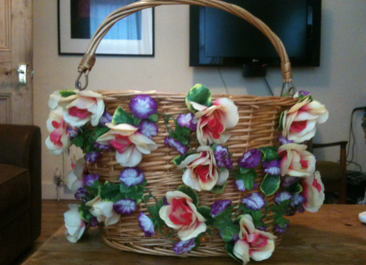
It has always been a dream of mine to have the sort of funky, flowery bicycle basket that you might see in Amsterdam – or North London. So, this morning I set out in the rain to buy all the supplies I’d need. The basket was an easy enough purchase, despite the rain. I popped into AW Cycles which is just down the road towards Wimbledon. It’s always made me smile that local bike shops never seem to have enough space in them for any customers, let alone the space to wheel your bike in for them to look at it, but somehow these guys seem happy in the eternally dark and cramped hovel where they work. They were very polite and helpful.

Then, into Tooting, where I knew I’d seen some excellent varieties of plastic flowers in a Pound Shop there. Unfortunately, the shop had been closed down. The windows brandished notices on all the windows that the shopkeepers hadn’t paid the rent, and the landlord had seized back the property. [Curious how my sympathy lay immediately with the shopkeepers and not the landlords, says a lot about our property law over here…].

So, I went on to Tooting Market, which I’m told was quite the place to be in the sixties, but which is now painfully down-market and average. But they had flowers, and they even gave me a discount (I’ve never been much of a barterer!)

I spent the afternoon with a needle, thread, picture wire and beads; and ended up feeling pretty darn smug.

I started with some leaves, attached with embroidery thread. Then added the flowers using wire we had for hanging picture frames. The completed basket is pictured at the top of this post, though I added a lining from an old Cath Kidston bag I had. Not sure if I’ll keep it in or not. It might be kitsch overkill…

This slideshow requires JavaScript.

‘And the bicycle?’ I hear you ask…. Well, with the money I’m saving not commuting into work everyday, I have bought myself a brand new bicycle to play with. It should be here in the next week or so!


Torn at the shoulder

The first time I went to the doctors with symptoms of depression, I was 19. My parents dragged me from my bed during the summer holidays and made me go. “We wondered when this would happen” they said, glumly. The doctor prescribed me a book. When I went back to see him two weeks later, he asked “How did you find the book?”
“I was too depressed to read it” I replied.
He put me on Prozac.
Many of my friends, when I returned for my third year at University, were happy to see how much better I seemed. I got a routine together. Having ham sandwiches everyday at midday made me feel as if I had suddenly found the meaning of life. I was overjoyed to finally be working like a ‘normal person’ again. Others were worried; the pills gave me such enthusiasm for life, I found myself in complicated and compromising situations. Before long, things didn’t seem quite so rosey anymore. I don’t remember when I stopped taking the medication, only that I didn’t check first with any doctor and just didn’t top up my prescription one day.
Since then, I have been on anti-depressants several times. People who have never experienced real depression before, won’t be able to begin to understand how lonely and frightening it can be. Here is not the time or place for me to explain it, suffice it to say when someone who is depressed is at their lowest points, even getting out of bed can seem like the most terrifying ordeal they can imagine. I am not a weak person. I am not useless, or stupid, or mentally impaired in any way other than the world sometimes seems to want more from me than I can give, and that is when I retreat into the comfortable darkness of this illness. It is all I have known for more years than I can remember.
This time, the darkness has taken a different form. It isn’t that I am miserable, per se, simply that everything seems a little too difficult for me and I am suffering levels of anxiety that are higher even than my normal levels. The idea of doing my day job, a job I have loved and excelled at for many years, is just too horrible. It is a scary place to be. The anxiety I feel about doing anything at all, brings with it some very real physical symptoms, which in turn, make me worry more. If you have never had a panic attack, you won’t understand how life-threatening they can seem.
Luckily I am surrounded by wonderful friends and family and understanding colleagues. I have a group of different professionals helping me out, and I have a plan to get back on my feet. It won’t be an easy journey, but it will be made a great deal more difficult by people who refuse to understand this illness – a disease that is probably more physical (i.e. in my brain) than emotional (in my head) – is anything more than an affliction suffered by people who are a bit spoiled and wet. Hopefully, I won’t meet any of them along the way.
This is a very public place to share this, and that is quite deliberate. If I had cancer, had broken my leg, or was suffering any other kind of illness I would probably not feel in the least embarrassed to write about it here. The fact that I thought twice about writing about depression is because of the stigma it has attached to it. But I refuse to be ashamed of this illness because it is as real and debilitating as any other sickness and, more than that, it could affect anyone, and nobody brings it upon themselves.

They f*ck you up, your Mum and Dad…

I was nearly thirty before I realised what a good job my parents had done. My mum used to say I became a teenager at nine, and I think I stayed that way for twenty years. Among the many horrible things I said about my parents, behind their backs and sometimes to their faces, was that I wished they’d never had kids, especially when they must have known we’d all grow up to have inherited all their worst characteristics and be total headcases. I wasn’t very keen on myself, then, either, and saw this as more proof that they’d done a terrible job and made me into a monster.

I inherited many weaknesses from my parents, and maybe they threw a few extras in there too just for me, but now (now that I’m an actual grown up and not just pretending to be one) I see that I inherited a great many of my favourite strengths from them as well. I was told at the weekend, by a friendly old vicar in Salisbury Cathedral, that growing up a vicar’s daughter is a real blessing. A few years ago, I might have argued with him about that. Growing up in a vicarage is a beautiful and terrifying thing, not least because you always feel that you have to be on your very best behaviour everywhere you go, so as not to let the Parish down. That obviously has an impact on your cognitive behaviour. But really, it is a lovely way to learn about community and social responsibility and charity, among other things. My father is a quite incredible human being, a man of faith as well as intelligence (seemingly so rare these days, if you listen to Richard Dawkins). He is creative and funny and very, very wise. When I was a teenager, I took his quiet acceptance of things as a sign of weakness, now I have nothing but admiration for his endless patience and love.

My mother was the one who got the worst of my teenage bitterness. I speak to women at work with teenage girls, who are at the end of their tether and cry on me about what more they could possibly do, and I think back to some of the things I said and did to my own mother with nothing but shame. I tell these women at work “Don’t worry, she might start talking to you again when she’s about 29” – which doesn’t really have the desired effect. For almost twenty years, I blamed everything that was wrong with my character and my relationships on the image I had of who my mother was, and no one could tell me otherwise. People said wonderful things about my mother to me all the time, speaking glowingly of this other woman they seemed to know, and I’d just looked at them, bewildered, and wonder who they were talking about.

Which makes me laugh now, but is a truly horrible way to think about your mother.

When I was about to turn thirty, I went to visit a counsellor for six months. Really, I was struggling with an increased workload, and the idea of turning thirty without having done very much, but mostly, this counsellor wanted to talk to me about my early childhood. I don’t have much of a memory, but I told her what I could. And, in the course of those conversations, I began to see the mother that everybody else had been talking about for all those years.

An intelligent and beautiful woman with a career, who put it on pause to raise four children and be the vicar’s wife. Who moved towns with her husband’s job having to make new friends every time she started somewhere new. A woman with three children under the age of 5, who got so bored sitting at home in a tiny place in Bedford that she set up a playgroup there from nothing. A woman who moved again with a small baby, and did the same thing somewhere else. A young mother who, finally having all her children at school, decided to change jobs and become a primary school teacher at one of the toughest schools in Oxfordshire. Then got bored and became a lecturer instead. And all the time, my mother was also the wife of the vicar, a job many of them still choose to do full time. And when her children all moved away and she was looking to retire? – then my mum decided to change career path once again and became a vicar, too*. I can’t imagine the kind of drive and determination that it must take to do all of these things to the high standards that she has for herself. I can’t imagine putting anyone, let alone five other people, first in my life and putting my own wants and needs second (or sixth). I can’t imagine how she did what she did and still managed to stay sane at all!

My mum came to visit me this afternoon, to look after me and give me a hug. She talked to me as though I was an adult, because I was finally behaving like one. We walked around Hyde Park and talked about all of the things I might have inherited from her. I talked about teaching, about how difficult I’m finding things, and she listened and she understood. She hugged me and told me she loved me.

In summary, and because I’ve not said it enough (if ever): I have the best mum in the world and I wouldn’t trade her for anyone. She’s also looking very good at the moment, having lost an incredible 2 1/2 stone since last time I saw her. We’ll be swapping clothes next…

*This isn’t a complete CV, I was very young in those days, and may have missed a bit.

On writing a Novel in Thirty Days

I haven’t blogged much in the last month choosing, instead, to save all my words for NaNoWriMo, which came to a close last night. I am writing these words as someone who has just written a 50,000+ word novel. I never thought I’d say that! I feel incredibly smug about having finished, not just because I reached the Sacred Word Limit, but also because I feel like the process of writing taught me a great many lessons.

Firstly, if you make an entire chapter of your book a conversation over email, you can spend a great deal of your words on the formatting of To, From, Date and Subject. But that’s cheating…

Seriously, it was a curious experience shutting myself up in my study every night after school and every weekend and just trying to get some words down. Some days it was so easy my fingers could barely keep up and I was averaging a thousand words every forty minutes. Other days, I thought I’d never be able to say anything at all and it was a real struggle to sit down and type anything. On a good day, the words seemed to be coming, not from my head, but from somewhere behind me – I was catching them as they flew past. Whole pieces of dialogue came to me from somewhere else, as though I was merely transcribing a conversation I was eavesdropping on. Some of the things the main character says about her friends and her husband, where so cruel I couldn’t believe I’d thought them up myself. Some of them were so funny, I wondered the same thing.
On days when the writing wasn’t coming so easily, I borrowed fairly heavily from real life. This is just one of the many reasons why I won’t be sharing the book with anyone I love.

Writing, they say, takes dedication. I always thought this would be the hardest thing about writing, I’m not a very organised person, and I find it difficult to commit to anything for a long period of time. But the times when I was writing, and writing well, were a real joy to me. I can write. I am a writer.

Throughout the month, the thing I was most bowled-over by, was the huge amount of support I received from the people around me. I’ve written before about why I felt the need to so publicly announce on facebook quite how many words I had, or hadn’t written each day. I needed to do it, at first, so that I might be spurred on by the threat of having to tell my facebook friends that I had caved and given in. But soon, the many posts I got from friends who were following my progress were the best thing about writing. It was beautiful to bask in their awe, their love, and I was really spurred on by them. Wordman came to make me tea as I wrote. The Husband cooked, cleaned, did my laundry and hugged me lots (he does all that anyway, even when I’m not working to a ridiculous deadline!). All the friends I saw over the month talked to me about my writing, suggested car chases and brutal murders, asked me what it was about. My tutor group, usually so lethargic and apathetic, asked on occasion how it was going. Without these people, I’m not sure I’d have finished as soon as I did.

Finding that you have over 50,000 words in your head that can be out down on paper is a truly incredible experience, and one which I recommend to anyone. I’d heard nightmare tales about losing my social life and staying up all night to meet deadlines. I didn’t find any of that I real issue, which maybe only suggests I don’t have a very exciting social life in the first place. I finished with days to spare and, whilst I can’t say that my mental health is unscathed by the incident, I feel a real sense of achievement.

As for the book, it’s a piece of cliched Chick Lit. But, in my humble opinion, it’s the best Chick Lit I’ve ever read…

NaNoWriMo. Day Seven.

Wordman tells me that he wouldn’t be telling people if he were writing a novel in 30 days, that he wouldn’t be updating his facebook status every thousand words, that he wouldn’t be sharing the day’s WORST WORDS with so many people. He says he’d be paranoid that by telling people, it would hex it somehow and the novel would never get done.
I do it for the exact opposite reason. The idea behind telling people the massive task I have decided to undertake, is that I will have to continue with it, even when (like today) I REALLY DON’T WANT TO. Because I have told them all I’m doing it, and I hate to look like an idiot.
This isn’t entirely true, however. The real reason I am constantly updating my facebook status to include all the words I have written that day is because I am doing nothing at all with my days but work and write, and because facebook is a fantastic way to procrastinate while still sitting in the study trying to prove to the Husband that I am writing.

Easy Sunday Mornings.

I moan a lot about where I live, telling the Husband that I hate the fact we have to live in London for his job. But, actually, where we live is really quite nice, and I consider myself lucky to live near such open spaces as Morden Park.
We went for a wander this morning, through the little park that is by our house, full of young families, playing on the swings. Down by the river past the bus garage, across the road to Sainsbury’s and further down the river, past Dean City Farm, which was bustling with children and their parents, all going to see the peacocks and the horses. We walked through the wetlands of Morden Park and on into the National Trust buildings where there is a tiny, second-hand bookshop selling such wonders as The Reader’s Digest Bedside Book of the Art of Living, which I picked up for a pound. Published in the 1950s, it’s proof that for decades people have felt out of touch with their fellow man, alienated by the modern world, distance from God.
Walking with the Husband is one of my favourite things to do. We talk more openly out in the fresh Autumn air than we can in a house where the TV is always on and there are other things to distract us. Walking with him is a free luxury, we should remember to do it more often.
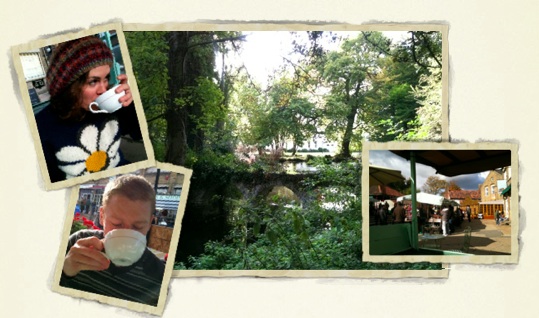
We stopped at Merton Abbey Mills for a cup of coffee. I love Abbey Mills. A former textile factory, it prides itself as London’s Alternative Market, which always makes us laugh given that we used to go to Camden a lot. But it’s where William Morris worked for years, and Liberty bought most of their fabrics from here before the 1970s. These days, there are little restaurants and market stalls which are ever so nearly right, but just not quite. I’d like to see more handmade crafts, less of the useless market tat you can buy on any street corner. It has a wonderful pottery place, though (featured on FaceJacker, if you watch that sort of thing) and we promised ourselves we’d go down their one weekend and get lessons. Abbey Mills is a great place to people-watch, I could probably stay there all day.
But we wandered home eventually, tired from our walk, cheeks reddened with the fresh breeze, to our little house, which I don’t hate as much as I say I do.

Closed-door writing

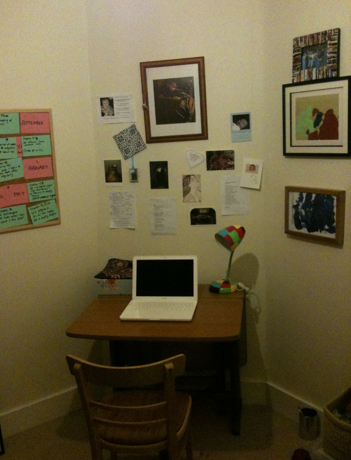
Stephen King in On Writing, says that you should write the first draft of any novel in a quiet space, without interruption, and you should never show it to anyone until it is finished. So, in preparation for writing my Great First Novel, I have sorted out the space in the spare room so I can work there. It’s not ideal – it’s where P keeps all his clothes (clean and dirty) and also the home for all that stuff that has nowhere else to live. But it is a space, nonetheless, and now that I’ve personalised it a little more, with pictures from my Favourite Little Person and a noticeboard full of PLOT, it feels much much better.
So. I’ve done the hard bit, right? Now I can just sit down and happily write a bestseller. In a month. While working full time. Yes.

New Writing App

To help me with my three pages a week, and to best utilise my time on the bus, and out for cigarette breaks, I have downloaded the My Writing Nook app on iPhone (Procrastinate? Me?)
I’ll let you know how it goes, but it looks pretty good – clean and usable. It synchs with Writing Nook on Google, and also gives you a very useful word count (good for NaNoWriMo, if, indeed, I ever get around to doing that).
Check it out here: http://www.mywritingnook.com